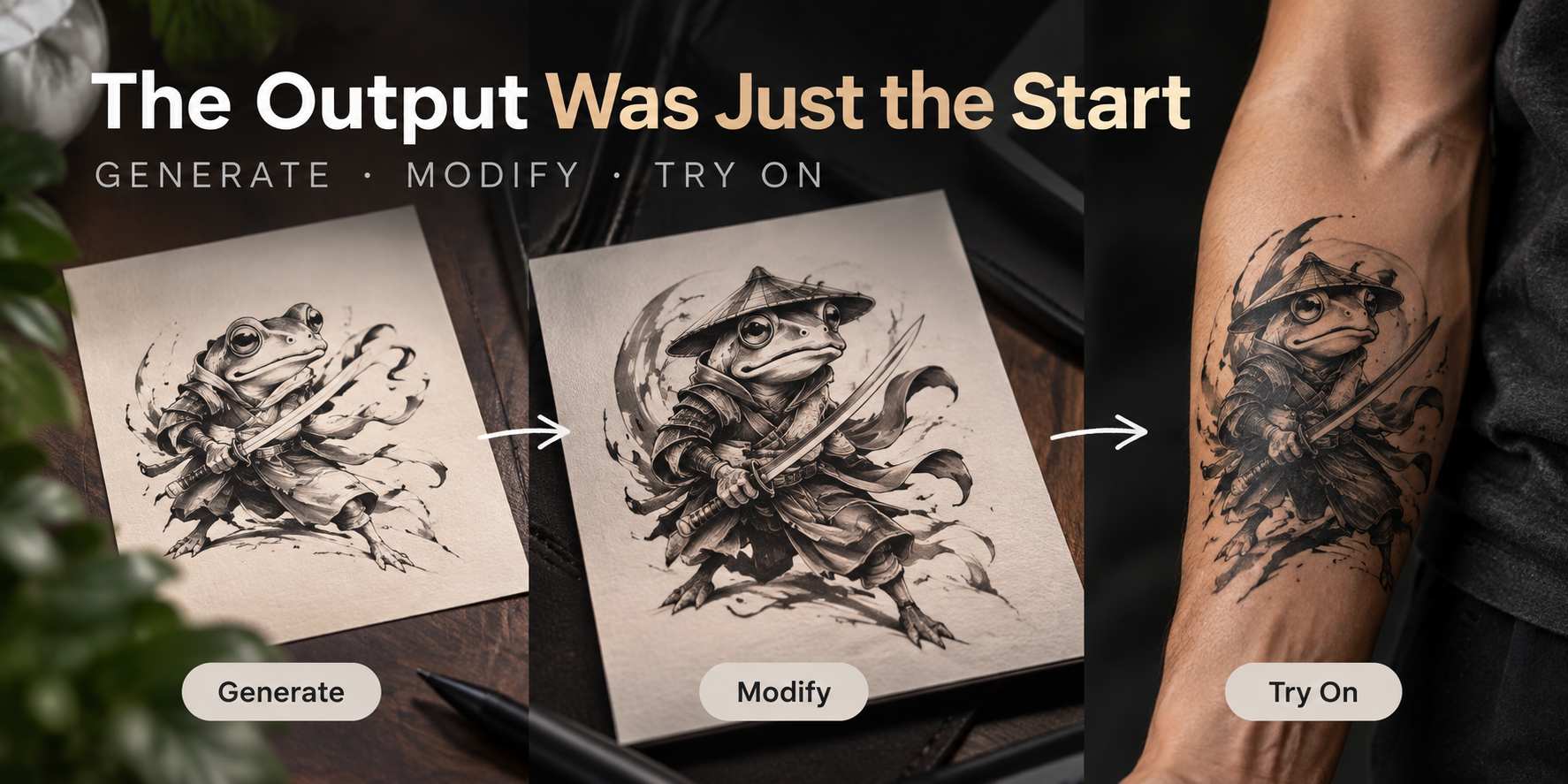
I Learned Where AI Should Stop Being Creative
Variation is useful in exploration. Predictability matters everywhere else.

I used to think the obvious way to improve an AI product was to add more AI.
If one part of the workflow could call a model, why not let the model handle more of the workflow?
That assumption held up for a while.
Then the product became harder to predict.
Not because the models were “bad.”
Because I was using a creative system in places where creativity was the wrong property.
Creativity was useful at the beginning
I ran into this while building AIMakeTattoo, a tattoo planning product that started with image generation and gradually expanded into lettering, refinement, placement, pricing, and other planning workflows.
At the beginning, model variability was a feature.
If someone entered:
a blackwork snake with flowers
I did not want the exact same output every time.
Variation was useful.
The user was exploring directions.
Different compositions, different balance, different visual interpretations — all of that was part of the value.
In that part of the product, unpredictability was not really unpredictability.
It was optionality.
That distinction turned out to matter a lot.
The problem started when AI moved into exact tasks
As the product grew, more parts of the workflow looked like they could also benefit from AI.
Text interpretation.
Routing.
Refinement.
Pricing.
Placement decisions.
Formatting.
At first, this felt like a natural extension.
But those tasks were not all the same kind of problem.
Some of them needed variation.
Others needed consistency.
And once I started treating both categories the same way, the product became harder to trust.
Exact text is not a creative problem
Tattoo lettering made this obvious.
If the user enters a name, date, initials, or Roman numerals, the text itself is not something the model should reinterpret.
If someone enters:
MCMXCIV
then “close enough” is not acceptable.
If someone enters:
J.R.
the product should not occasionally decide that the punctuation does not matter.
Visual style can vary.
The exact string cannot.
That sounds obvious when written down, but it is surprisingly easy to blur those two responsibilities when everything is pushed into one prompt.
Eventually I started separating:
- exact text
- visual style
- decoration
- composition
- supporting context
The model could be creative with the visual layer.
The product stayed deterministic about the literal content.
Dates made the boundary even clearer
Roman numeral tattoos are a good example of where creativity becomes dangerous.
A user does not want an interesting interpretation of a date.
They want the same correct conversion every time.
They want to know:
- whether the date order is correct
- whether the numerals are correct
- whether separators are clear
- whether spacing is readable
- whether the final layout still makes sense at tattoo size
That is why I keep that workflow deterministic in the Roman Numeral Tattoo Generator.
The model can help with visual inspiration elsewhere.
The conversion itself should not be creative.
Pricing had the same problem
Tattoo pricing looked like another place where AI might be useful.
You could imagine asking a model:
How much should this tattoo cost?
The answer would probably sound reasonable.
That is exactly the problem.
A reasonable-sounding number is not the same as a predictable planning model.
For pricing, I would rather have explicit inputs:
- size
- placement
- style
- color
- complexity
- hourly rate
and return a bounded range.
The product may be less “smart” in the theatrical sense.
But it is easier to understand, easier to debug, and easier to explain.
Placement did not need more intelligence either
Placement was another interesting case.
I initially thought a more advanced AI system might help users decide where a tattoo should go.
But a lot of the useful work is simpler than that.
Users often just need to:
- move the design
- resize it
- rotate it
- compare two placements
- see how it feels on a body photo
Those are interaction problems.
They do not necessarily need another model call.
In fact, making them deterministic makes the experience faster and more controllable.
The user can make a small change and see exactly what happened.
No reinterpretation.
No surprise.
The question I started asking instead
I eventually stopped asking:
Can AI do this?
That question is too easy to answer.
The answer is usually yes.
I started asking:
Would I be happy if this gave a slightly different answer every time?
That turned out to be a much better test.
If the answer is yes, the task may benefit from a generative model.
If the answer is no, I should be very cautious about putting a model in the critical path.
That simple question changed how I think about AI product architecture.
Where variation helps
I still use AI where variation is valuable.
For example:
- concept generation
- style exploration
- alternative compositions
- visual refinement
- image transformation
In those areas, different answers are useful.
The user is exploring.
Where variation hurts
I prefer deterministic behavior when the task depends on consistency.
For example:
- exact text
- date conversion
- input routing
- pricing rules
- saved state
- history
- transforms
- validation
- UI behavior
In those areas, “creative” can quickly become “unreliable.”
This changed how I think about AI features
I used to think adding more AI made a product more advanced.
Now I think the harder question is where AI should stop.
The goal is not to maximize the number of model calls.
It is to put uncertainty only where uncertainty is useful.
That usually means letting AI be creative at the edges of exploration, while keeping the core decisions, state, and rules predictable.
The product became easier to trust once I started treating those as two different systems.
And that is probably the biggest change in how I build AI products now:
AI should be creative where users want possibilities.
It should stop being creative where users need consistency.
About the author
- Building browser-side workflow, privacy, and metadata utilities. Interested in AI workflows, semantic SEO, and lightweight developer tools.
Comments
Join the discussionNo comments yet. Be the first to comment.